Monday, October 8, 2012

Morning Thoughts

When the wind blew on my face this morning, I had a thought, don't know whether to call it poetic or not, but would like to share the thoughts with you

ഇന്ന് വീശും കാറ്റിലൊരു നനവുണ്ട്
ഇന്ന് പുലരുന്ന പകലിനൊരു കനവുണ്ട് 
അര്‍ക്കന്റെ ദൃഷ്ട്ടിക്കൊരു കനിവുണ്ട്
ഇനി വരും ശൈത്യത്തിന്‍ കുളിരുണ്ട് 

കാണാത്ത നാളെയ്ക്കൊരു നന്മയുണ്ട് 
മനസ്സിലെന്നും വിരിയുന്ന പൂക്കളുണ്ട്‌ 
കര്മത്തിനെന്നും ഒരു വിധിയുണ്ട് 
പറയാത്ത കഥകള്‍ ഇനിയുമുണ്ട് 

നാട്ടിലേക്ക് എത്തുവാന്‍ ഒരു കൊതിയുണ്ട്
നാട്ടിലെന്നും എനിക്കായൊരു ഇടമുണ്ട്
മടങ്ങാന്‍ ഇനിയും ഒരു വഴിയുണ്ട്
വരവിനായ് കാത്തിരിക്കും എന്‍ അമ്മയുണ്ട്‌ ...

ഒരിക്കലും തീരാ പ്രതീക്ഷയുണ്ട്
എന്നും തിരിയും കാലച്ചക്രമുണ്ട്
തിരിയും ചക്രത്തിനൊരു ഗതിയുമുണ്ട് 
ഈ കവിതയില്‍ എന്നും എന്‍ കൊതിയുണ്ട് 

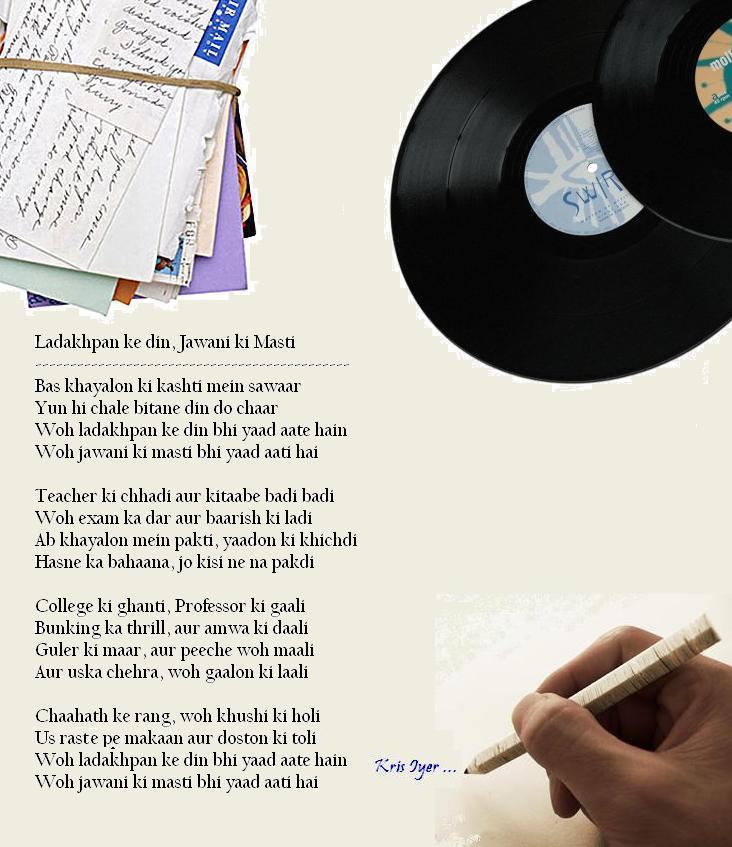
A version of my morning thoughts in hindi

बहती हवा में आज एक ठंडक है
उगते दिन में एक चाहत है
सूरज कि बाँहों में आज एक ममता है
आनेवाली ठंडी कि आहात भी है
अनदेखे कल में एक आशा भी है
दिल में गुल कि गुलषण भी है
हर कर्म कि डगर में फल भी है 
अनकही कहानियाँ और भी है

अपने चमन को छूनेकी एक चाहत है
चमन मेरे लिए खुला आस्मां भी है
वापसी कि कोई एक राह भी है
उसी आस में जी रही मेरी माँ भी है

हर वक़्त उनकी दुआ भी है
हर पल समय का भंवर भी है
उस भंवर में साथ मेरा हमसफ़र भी है
बस इस कविता में मेरी चाहत भी है

Kris Iyer

Saturday, September 1, 2012

Samyogam and Viyogam ...

In our day to day life we attach ourselves to different things and we face junctures where we have to set us apart from some of our favorite things. The pain in separation and joy of union are constantly in our lives. Is it a must that we have to go through the same. And the answer is

"YES"

That's the rule of the nature. We have to learn to accept the union and separation with equal importance or should I say unimportance. When the rain drops fall from the rain clouds to the earth it has to be sad that it lost its space in the heavens, and when it becomes a stream, it should be happy, then the river engulfs the stream in itself, then there is sadness of it no longer being a stream and when it reaches the sea, the river loses its individuality. The happiness and sadness cycle continues till the moment till the heat of the sun takes it back to the heavens and makes it a rain cloud. Simply explained in one of the daily prayers in Hinduism

"akashaath pathitham thoyam
yada gatchathi saagaram,
Sarva deva namaskara: 
Kesavam prathigatchathi"

(Which means like the drops of rain form the stream and reaches the sea, 
which will be back to the clouds similarly the prayer to all gods reach the one)

In a similar fashion whatever you get or lose is just meant to be, and you get back to where you started as a part of the divinity. You get back to the Paramatma or the supreme soul, which you are a part of. If we understand the lesson in nature where the union or separation is not celebrated or mourned but it is a cycle, then each one of us can lead a peaceful life.

Then what is it that stops us from doing so. We have to understand the thought before we can act on it. On a micro level think of the happiness associated with the union of your favorite gadget and the sadness when it conks off.

On a macro level think of the country that stood together to fight for its independence and the rivalry that the two countries which got separated and are fighting ever since on all issues. Will it unite again - cant say. But think of the states which form our country India, where we have internal feuds related to states and the water which flows. The happiness which was celebrated as the day of independence lead to the sadness of internal feuds. Its the rule of the nature.

“And one by one the nights between our separated cities are joined to the night that unites us.” 
― Pablo Neruda

We should learn from our mother nature, who teaches us to take the union or separation, happiness or sadness, victory or defeat, all alike. Life would be better if we can understand this lesson

Lets strive towards a world in peace and not n pieces. Union and separation are a part of our life, lets take it to a next level where there is tranquility and that in itself is "Nirvana"

Niravana - is an ancient Sanskrit term used in Indian religions to describe the profound peace of mind that is acquired with moksha (liberation). In shramanic thought, it is the state of being free from suffering. In Hindu philosophy, it is union with the Brahman (Supreme Being).

Lets not mourn that during our birth when we cried as a child for the separation from the paramatma, separated from the mother, but lets live a life which will take us back to the supreme being - The ONE

- vaazhka bharatham - 

Tuesday, February 22, 2011

Train - ed to remember ...

 
Koooooo.... chuk chuk chuk
 

My childhood memories still hold the game of playing “train train” with the first kid being the engine and others holding on to the dresses as compartments. Train journey is always remembered with delight. Mainly terms are coined related to trains and train journey like in Tamil one time friendship which does not last long is called "rail sneham" (translated as rail friendship). Many philosophical thoughts have been derived from the locomotive.


My early memories of a train journey was the annual family trip to Trivandrum to my grandparents in a "kalkari theevandi" (coal powered steam engine). The smell of the burning coal, the unique sound of the engine's hoot, now only heard in cartoon series of "Thomas the tank engine". The journey was indeed I used to look forward to though the odor which it leaves behind used to take at least a day before it subsides. Then came the next generation Diesel Engines and now electric coaches & metro rails. Innovation has left behind indelible inscriptions in our minds. 


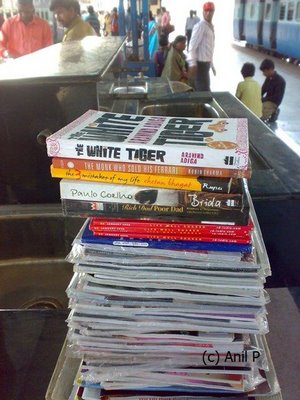
When I talk about the trains, the stations, or platforms as we refer to it as, also come to our minds. There used to be a system of guards and the driver exchanging locks and keys in the olden days. Small lights in the hands of a station master clad in his white and white and a black jacket. The ticket examiner coming to your seat checking the validity of the tickets you have, those olden days card tickets punched with the unique number at the station counter, the policeman travelling in the coach, the coach attended in the air-condition car coming to ask whether you would like your blanket now, the canteen attendant who takes your order for the nights food and many more. Those yellow station boards and how you try and read the name in the regional language. The vendors and hawkers, the Higginbotham’s or Wheelers book shop in every station, the restaurants and each station having its own specialties.
 
Let us trace back and think of railway stations and what they were famous for 
 

  • Pune - Tea, Misal, and Patties in the canteen 
  • Karjat - Batata vada and vada pav
  • Lonavala - Chikki
  • Kolhapur - Sugarcane juice 
  • Mysore - Dosa 
  • Tiruchirapalli - Bonda
  • Hyderabad - Chicken biryani 
  • Calicut - Dal vada, Halwa
  • Quilon - Porotta and Egg Curry, Cashew nuts
  • Mangalore - Egg Biryani 
  • Ernakulam - Pazhampori (banana fry)
  • Nagpur & Satara - oranges 
  • Rajmundhry and Guntakal - Mango jelly 
  • Chennai Central - Samosas, idli, dosa 
  • Rameshwaram - Idiappam
  • Agra - Petha
  • New Delhi - Aloo chat
  • Indore - Farsan 
  • Ranchi - Puri bhaji 
  • Howrah - Sandesh 
  • Bangalore - Vada sambar, fresh fruit juices 
  • Jaipur - Dal bati 
  • Varanasi - Guava
  • Guwahati - Tea (Assam blend) 
  • Madurai - Uthappam 
  • Ratnagiri - Mangoes, dried jackfruit 
  • Allahabad - Motichur ladoos 
  • Coimbatore - Sambar-rice, tamarind-rice, lemon-rice 
  • Bhopal - Channa
  • Dwaraka - Milk pedhas 
  • Thanjavur - Salted cashew nuts 
  • Maddur - Maddur-vade 
  • Panruti - Jackfruit 
  • Virudunagar - Boli (Similar to puran poli of maharashtra)
  • Sankarankoil - Chicken biryani 
  • Srivilliputtur - Paal kova 
  • Manapparai - Murukku 
  • Vijayawada - Bread Omelets
  • Kannur - Biriyani and Banana
Buying a book or a magazine from the Higginbotham’s / Wheelers book store, sipping the coffee from the vendor who calls out to you whether you want coffee (as sweet as your wife ...), while you travel with the jolt as if your mother was trying you to put you to sleep, you will come across the best of the sights outside the chugging train. The sunrises and the sunsets, the fields and farms, kids playing out in the sun beating the heat and sometimes waving at you, the rivers and lakes, the bridges and the roads you see outside, the dhobi ghats and the small shops - all accompanied by the rhythmic beats of the travelling train. 
 

Have you not remembered to write to the friendly person who sat next to you in a long journey sometime in your life? Do you remember the office goers regularly meeting everyday in the train, the flower vendors, college students travelling back home, salesmen who sell pens and other utilities, poor kids trying to sell the packs of candies, those packets of peanuts, the blind man in the train singing songs with the beats of clattering wooden spoons in his hand. When we get down at the station, greetings are exchanged and promises are made to the co passengers being sure to write and addresses are noted down. I am sure letters are rarely written and mostly even the faces forgotten by the time you again board another train for another memorable journey.


Indian Railways...would narrate more stories than those can be made into movies which will touch your hearts...I am sure those who have used the Nilgris Express narrow Gauge train would have a different story to tell. Sadly thats the last narrow gauge steam locomotive, in India, still in use.

- vaazhka bhaaratham -

Tuesday, January 25, 2011

India is my country ...

As a casual read I was searching for articles and lesser known facts about India. With my mind attendively lingering with the national song vande matharam from Bankim Chandra Chaterjee's "Anandmatt", I was wondering why the personification and when it started. My search started with google and took me to a wiki page where the following was the explanation:

(The first drawn personification of Mother India)


" Bhārat Mātā, Mother India, or Bhāratāmbā is the national personification of India as a mother goddess. She is usually depicted as a woman clad in an orange or saffron sari holding a flag, and sometimes accompanied by a lion. The image of Bharat Mata formed with the Indian independence movement of the late 19th century. A play by Kiran Chandra Bandyopadhyay, Bhārat Mātā, was first performed in 1873. Bankim Chandra Chattopadhyay's 1882 novel Anandamath introduced the hymn "Vande Mataram" which soon became the song of the emerging freedom movement in India. Abanindranath Tagore, Gurudev Rabindranath Tagore's newphew, portrayed Bharat Mata as a four-armed Hindu goddess wearing saffron colored robes, holding a book, sheaves of rice, a mala, and a white cloth.The image of Bharatmatha was an icon to create nationalist feeling in Indians during the freedom struggle."

It was enlightening information that there is a temple dedicated to Bharat Mata.In 1936, a Bharat Mata temple was built in Benaras by Shiv Prashad Gupt and was inaugurated by Mohandas Gandhi. Mahatma Gandhi said, "I hope this temple, which will serve as a cosmopolitan platform for people of all religions, castes, and creeds including Harijans, will go a great way in promoting religious unity, peace, and love in the country." A Bharat Mata temple in Haridwar was built by in 1983 by Vishwa Hindu Parishad (VHP).

All these are things which you can search for but the person who personified India as Bharath Mata seems to be lesser known or not much details about him are available. But lets come to the present day. Will you find her happy as she was portrayed in the picture? Internally we are facing so many issues that we are weakened by them. We read about scams everyday and those we dont read about are happening now. When can we expect her to smile again. The question is a big one.

Starting from the attitude towards our land and its culture to the present day political scenario, we Indians should find a way to make India proud again. A Land which welcomed all alike, a land which gave birth to leaders and visionaries from the start of human history, needs to be given its due importance. On the 61st anniversery / 62nd republic day lets remind ourselves of a country which Gurudev had envisaged.


Where the mind is without fear and the head is held high;
Where knowledge is free;
Where the world has not been broken up into fragments by narrow domestic walls;
Where words come out from the depth of truth;
Where tireless striving stretches its arms towards perfection;
Where the clear stream of reason has not lost its way into the dreary desert sand of dead habit;
Where the mind is led forward by thee into ever-widening thought and action--
Into that heaven of freedom, my Father, let my country awake.

Also I would like to remind every Indian about a pledge that we used to take, when we were in school. Dont know whether we still remind ourselves about the same.


India is my country.
All Indians are my brothers and sisters.
I Love my country.
I am proud of its rich and varied culture.
I shall always strive to be worthy of it.
I shall love and respect my parents, teachers and elders.
To my country and my people I pledge my devotion

Lets remember these lines and prove that we had pledged our devotion to the country. Lets also get to know our national insignia

NATIONAL FLOWER- Lotus
NATIONAL BIRD- Peacock
NATIONAL ANIMAL-Tiger
NATIONAL TREE- Banyan
NATIONAL FRUIT- Mango
NATIONAL GAME- Hockey and not cricket

Till India became a Soverign Republic there has been many important events. Lets run through it together:

2500-1500 B.C :Indus Valley civilization.
1500-200 B.C :Aryan civilization.
2000-1000 B.C :Composition of the Upanishads and the great Epics, the Mahabharata and the Ramayana.
600-500 B.C :Mahavir and Buddha lay down the principles of Jainism and Buddhism.
326 B.C  :Alexander, The Great invades India
78A.D  :The Saka era begins.
1498 AD  :Vascodagama lands at Calicut.
1600 A.D  :East India Company formed.
1853 A.D  :First Railway between Bombay and Thana.
1857 A.D  :The Sepoy Mutiny.
1858 A.D  :Government of India passes from East India Company to the British Crown.
1885 A.D  :Indian National Congress born.
1911 A.D  :Capital of India shifted from Calcutta to Delhi.
1931A.D  :Inauguration of New Delhi.
1947 A.D  :India gets freedom. Nehru is India's new Prime Minister.
1948 A.D  :Mahatma Gandhi is assassinated in Delhi.
1950 A.D  :India becomes a Republic.


- vaazhka bharatham -

Monday, January 24, 2011

A question which "Google" did not answer...

I encountered a question which really made me think and wanted to know what the answer could be. As humans we have been facing a whole lot of queries which lead to all the inventions and discoveries in this world. The most useful these days could be the Internet. Communication, Entertainment, Networking, Socializing and the opportunities are inexhaustible. When we think of Internet most of you will agree you will start thinking about it with Google as a standard. There were many search engines since the beginning of the Internet but Google seems to have taken the world in its way. But the question which my friend asked me made me search an answer for it in the Google when I could not think of an answer, but even Google did not have an answer for it.


The querry was very simple.
What are the basic unit of thought?

Suraj, my colleague, with a smiling face asked me during the lunch hour while we were having our grub. The thought itself is shocking as I had never thought of it. If that thought can be measured then how can it be done? I suggested thinking of time as a base for thoughts as all our thoughts are about time and phases in our lives which have a time stamp - past present or future. But to that the retort was at that instant. The thought spans even a fraction of a second. So could the unit be nanoseconds or milliseconds. But the complexity increases. What if it is devoid of a timestamp as that is also a possibility?

In thoughts we can have many attributes images, symbols, concepts and the like.

Image: A visual, mental representation of an event or object
Symbol: an abstract unit of thought that represents an object or quality; anything that stands for or represents something else
Concept: a label for a class of objects or events that have at least one attribute in common
Prototype: a representative example of a concept
Rule: a statement of relation between concepts

And so time cannot be a measure used to describe it. Then I continued my quest for an answer. That’s when I stumbled upon a way to express a thought - in a sentence. A thought can be a simple sentence or even a complex one. It can be active or passive. Even when we research on language we come across a definition for "Sentence". Not as the sentence as in punishment but an element of language grammar. A sentence is commonly defined as "a complete unit of thought." Normally, a sentence expresses a relationship, conveys a command, voices a question, or describes someone or something. It begins with a capital letter and ends with a period, question mark, or exclamation mark.


Thought the answer has not satisfied me this could be it. My quest continues but for the moment I rest my case and believe that thoughts can be measured in a sentence. Sometimes thoughts can span into many sentences, paragraphs or even volumes. May be they are the higher units of thoughts.

When you search for a thought in google you might come accross things like:

"Thought" generally refers to any mental or intellectual activity involving an individual's subjective consciousness. It can refer either to the act of thinking or the resulting ideas or arrangements of ideas. Similar concepts include cognition, sentience, consciousness, and imagination. Because thought underlies almost all human actions and interactions, understanding its physical and metaphysical origins, processes, and effects has been a longstanding goal of many academic disciplines including, among others, biology, philosophy, psychology, and sociology.

The only thing I can tell you is to think about it in as many sentences as possible. The quest continues...

- vaazhka bhaaratham -

Sunday, January 23, 2011

Must watch Movies ...

As promised in one of my previous blogs, here are three movies that can change the way you look at movies

Majid - An Experience you should not miss
Language: Morrocan (Arabic)
Directed by Nassim Abassi

A simple tale about a son's urge to have a photograph of his parents and his efforts to get. The relationship between him and his brother, who aspires to grow up in life and his life revolving around his daily chores as a shoe shiner captures the eye of a viewer. A carefully narrated movie takes us to a different world in and around a small town Mohammedia, the director's hometown. Nassim Abassi, the passionate Moroccan director, weaves this simple yet beautiful story Majid (2010), is about a ten years old orphan boy called ‘MAJID'.

The story of MAJID, set in Mohammedia, revolves around a coming of age story of a ten years old Moroccan orphan called Majid who works as a shoe shiner in the town's streets. Following recurrent nightmares, he learns that he can't remember his parents' faces anymore and that there are no photographs of them apart from the charred remains of a family photo with his parents heads burnt away in a fire. With the help of his new friend Larbi, an eleven years old cigarettes seller, Majid decides to go on a quest to find a photograph of his dead parents. It's a journey that will take them to the big city of Casablanca where many dangers and adventures await them. The characters of the movie like the street urchin Hogra, the rich business man Zougi and his wife, who were his father's friends, and the people at the mosque all add to the spice of the movie. After you watch this movie, you do realize that we tend to forget the past so easily.

Nassim Abassi started writing MAJID fifteen years ago, during his studies at a film school in the UK and only finished it three years later. The situation of cinema houses in Morrocco is also bleak as per the director of the movie. Over the last few years more than half of Moroccan cinemas have closed down. In Mohammedia, with 300000 inhabitants, people don't have any cinemas anymore as the last one, Cinema Miami, was knocked down last year to make way for a new business. With the resources India has we ought to make better movies, at least watching this movie will kindle the art of storytelling in celluloid in the hearts of many.


Hottarake no Shima: Haruka to Maho no Kagami
(Oblivion Island: Haruka and the Magic Mirror)
Language: Japanese
Directed by Shinsuke Sato

A story which will put an insight in your minds – “whether to cherish the memories or forget them”. The beautifully animated adventure makes you forget the real world and takes you to another world of fantasy. The story is about Haruka, the 16-year-old high school student living with her father, who lost her mother at a young age. The father who tried to get over the grief of his wife's demise turns gloomy, which turns Haruka to be bickering and hence the relation between them gets strained.


The adventure begins when one day Haruka leaves to visit her grandmother in Musashino. On her way she stops by at a shrine where she sees, Theo, a little fox like creature who steals her trinket with keys. Theo carries anything and everything discarded by humans. Haruka sets on a chase behind Theo and in the woods, she finds a mysterious puddles. Lukewarm water in the puddle turns out to be entrance to the strange world of "Oblivion". An island without humans humans filled with all that has been discarded by humans in their lives. Haruka decides to search for a hand mirror which was given to her by her mother and once close to her heart. The adventure goes through many interesting twists and turns with Kotton a rag doll, Baron and his allies in the island and whole lot of characters. Watch it and you might start thinking about those yester years in your life.
Le scaphandre et le papillon
(The Diving Bell and the butterfly)
Language: French
Author: Jean-Dominique Bauby
Directed by Julian Schnabel

A movie that taught me how to think in celluloid. The pains taken by Julian Schnabel and Pathe movies, to communicate pain and distress, have been successful. A must watch if you think you like movies. The narrative might seem a bit slow, but come to think of it, the movie at least has some story behind it. Many a times, I watch movies till the end and still wait for a storyline to start. The movie is about a man who has reached the pinnacle of life loses it in an instant and his life thereafter. The desire to communicate in a person, and his thoughts when he is not able to express as he used to. His life and relationships post a tragic phase in his life.

On December 8, 1995, Bauby, the editor-in-chief of Elle magazine, suffered a stroke and lapsed into a coma. He awoke 20 days later, mentally aware of his surroundings but physically paralyzed with the exception of some movement in his head and eyes (one of which had to be sewn up due to an irrigation problem). The entire book was written by Bauby blinking his left eyelid, which took ten months (four hours a day). Using partner assisted scanning, a transcriber repeatedly recited a French language frequency-ordered alphabet (E, S, A, R, I, N, T, U, L, etc.), until Bauby blinked to choose the next letter. The book took about 200,000 blinks to write and an average word took approximately two minutes. The book also chronicles everyday events for a person with locked-in syndrome. These events include playing at the beach with his family, getting a bath, and meeting visitors.The French edition of the book was published on March 6, 1997. It received excellent reviews, sold the first 25,000 copies on the day of publication, reaching 150,000 in a week. It went on to become a number one bestseller across Europe. Its total sales are now in the millions. Bauby died two days after the book was published, on March 9, 1997, of pneumonia.

The movie tells us a story at the same time makes you think about the merits of what we have now and what we may not have in the next moment. A must watch

Enjoy the movies ...

- vaazhka bharatham -